Uncategorized

The Only Jewelry I Own

I am presently participating in a writing class offered through the Literary Kitchen and one of my writing mentors, Ariel Gore. Among our assignments each week is a ‘Quick Write’ exercise, which is to be completed in eight minutes or less, in response to a prompt. For this week’s QW, the direction was to ‘Read the prompt. Allow an image to come to mind from early in your life and write to that image. The prompt: A piece of jewelry. Here’s my QW assignment:

It’s one of my earliest recollections. I’m not sure how old I was—four, maybe? I was lying across my dad’s lap, watching Saturday morning cartoons. Dad was rubbing my back.

His hands were rough; scratchy on my back. I turned back to him and said something about it. He opened his hands in front of me. I could see the rough skin, nicks and callouses across his palms and up and down each of his fingers. I also noticed the gold band—his wedding ring—that rode, loosely, his ring finger.

“What happened to your hands?”

“That’s from hard work. They’re like that because I work hard with my hands to take care of you and your brothers and sisters, because I love you.”

I twisted the ring on his finger. “And why do you wear this?”

“It reminds me that I made a promise to your mom to be the best husband I can be.”

I forgot about that conversation immediately. Cartoons were on, after all.

It came flooding back some twenty years later. Having proposed to my girl, and in the excitement as I shared that news with my family, my Mom pulled me aside.

“I wonder if you’d like to have this?” she said, retrieving my dad’s wedding ring from her jewelry box. “He’d be proud to have you wear it. It comes with a lot of responsibility—he was a great husband and father. You’ve got big shoes to fill to be a husband like that.” I flashed back to the back rub, rough hands and that gold band on his finger: “… Hard work because I love you … I made a promise to your mom …”

“I’ll be honored to wear his ring. Thank you!”

I don’t think a day passes apart from my seeing that ring on my hand, or twisting it on my finger—thinking of Dad—and remembering the promise I made to my wife, and the promise we made in bringing our children into this world. It’s an invaluable piece of jewelry—the only piece I own.

Uncategorized

Help! Grammar Man!

grammar-man“Take it easy, Ma’am. Just tell me what happened.”

“I always put on my glasses before I brush my teeth–ever since I used my husband’s hemorrhoid cream by mistake. So I put on my glasses. I picked up the tube. I looked real close–you know, to be sure. And there it was! Right on the side of the tube! See for yourself, officer,” she handed over the evidence. (See photo.)oops

The officer was astounded at what he saw. “This is very serious, Ma’am. I’m afraid this is a job for … Grammar Man!”

The Case of Everyday Confusion

You see this mistake every day. And if you’re wired like Grammar Man, this everyday oops launches a migraine every time. People, please! The one word modifier everyday and the two-word phrase every day are not interchangeable. Say it with me: NOT interchangeable!

You see, it’s this simple: the one word everyday is an adjective while the two-word phrase every day is an adjective coupled with a noun, and together they usually work adverbially. Voila! You with me?

The adjective everyday means ordinary or commonplace. Listen to Sly and the Family Stone? They sang, “I am everyday people!” What kind of people? Everyday people. Regular. Ordinary. Like everyone else. Race, ethnicity, heritage, creed–can’t we all just get along? That’s his point. We’re all everyday people. Sly knows his grammar!

Buddy Holly? Not so much. Consider lyrics from the B-side of Peggy-Sue, a song unfortunately titled ‘Everyday’: Everyday, it’s gettin’ closer … Everyday it’s gettin’ faster … Everyday seems a little longer … When our great grandparents told our grandparents that the longhaired music of the 50s would corrupt them, now you see why! What Buddy meant to convey was that with each day, love was one day closer. So, then, let me help: Every day, it’s getting closer. Every day, it’s getting faster. Every day seems a little longer.

So, back to the Crest tube. Should you “Use everyday for whiter teeth” or “Use every day for whiter teeth”? Aha! This is why Grammar Man uses Colgate.

And here is a key, my friends: If you can substitute the phrase ‘each day’ in the sentence, than ‘every day’ needs to be the two-word phrase. Everyday–of the one word adjective variety–could be substituted for with ordinary or commonplace. Use these simple little tricks and you’ll never get this one wrong. And you might just spare Grammar Man a migraine.

What gets your grammar dander up?

Uncategorized

Show Don’t Tell

The first and most frequently repeated tip a wannabe fiction writer is given is show, don’t tell. You’re writing a story. Therefore you are telling a story. You are a storyteller. No one has ever heard of a story-shower. Show, don’t tell? What exactly does that mean and how do you accomplish it?

Simply put, showing allows a reader to follow the story into a scene or setting, as if they were there. There, they can feel and experience the story unfolding with the characters. It draws a reader into the story using all of their senses. Working a healthy balance of showing and telling into your story can engage your reader.

Here are five suggestions for ways in which you can show:

Dialogue. This is a staple in your toolbox to show readers something. Consider this example. You can tell: “Dad was really angry.” Or your reader can hear it for themselves: “Darin!” Dad shouted, “Get over here right now! What were you thinking? I brought you into this world, Son, and I’ll take you out!” (Wow. Flashback!)

And in that example, I’m reminded of a time I’ve seen, or heard, or otherwise experienced before. Now I’m able to connect with the characters in the story in a more personal way. Dialogue is a great way to convey emotion, attitude and give great insights into a particular character’s persona. You don’t need to say “Bobby was a jerk.” You show them in dialogue. And they’ll appreciate it all the more.

Sensory descriptives. When you want to show a scene, thinking about your reader’s many senses and appealing to them can help. Warning, though–this can easily be overdone. So proceed in moderation. Consider the mega hit from the rock band Journey for a moment, otherwise known as Tony Soprano’s swan song–Don’t Stop Believin’. “A singer in a smokey room; smell of wine and cheap perfume…” It paints a picture, doesn’t it? Brings you there much more than if he’d have simply sung, “There was a singer in a bar.” Sensory descriptives appeal, because we’ve all got a sense for what a smokey room would  ‘feel like’ to us. An asthmatic, I start to wheeze when I hear Steve Perry sing those words! Everyone has some sense of what a boozy, alcohol saturated smelling room might be, or how overwhelming cheap perfume–especially in excess–can be. So we can put ourselves in the scene.

Adjectives and adverbs. Okay, back to grammar class. You remember what adjectives and adverbs are used for in language. Again, a caution: don’t over do it. This is another one that easily identifies sophomoric writing. Here’s a hint: Can you use adjectives and adverbs to speak into the sensory descriptions mentioned above? If you can, that would be far better than loading up on gag-reflex redundant adjectives: She was very meticulously dressed in a deep ocean blue, sequined blouse, with a thick, wool scarf of fuchsia, and wore a cute, little, raspberry beret, tilted… {closed the book}.

Figurative language. This is another good tool to be applied in moderation. This one is easy to over exaggerate. You can tell: “the virtuoso played his cello.” Or you can show by using some figurative language: “he and his instrument were one, making beautiful music together.” Or, as mentioned, you can go way overboard: “like lovers they melted into one another…” Yeah … Awkward.

Specifics. When you’re finished with a story, or you’re through with a section and ready to do some revising, go back through and find every place where you’ve been vague and get specific. For instance, if you wrote: “She had never felt like this before”, spend a few minutes imagining the specific feeling, and revise. Show us what that feeling felt like to the character–and let us determine how absolutely amazing it was, something we’d never felt before.

Now, a disclaimer. I don’t share all this with you because I think I have mastered it myself. I’m very much an artist–trying. I do hope that these suggestions provide some thought provocation for you as you work on your craft, much as they do for me. So let’s get to work–showing.

Do you have any suggestions for showing that have worked well for you–either as a writer or as a reader?

Uncategorized

The Write Tools

My writer friends and I often talk about the tools we’ve discovered to actually help us put words on a page. Those tools range everything from hardware to software, pens to moleskine journals, settings to environments, snacks to libations. I’ve decided to sing the praises of a few of my writing tools here in a series of posts.

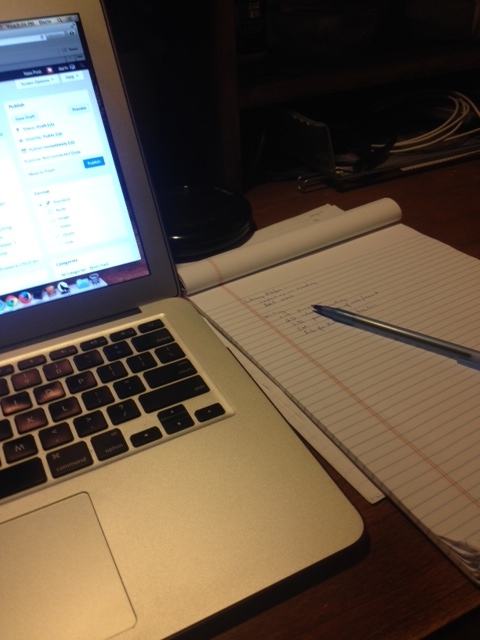
photoIn earlier posts I’ve shared the computer hardware and software that powers my writing endeavors, and a few of the old-school reference books and resources I turn to as I write. Today I want to share some of my favorite accoutrements. Good thing I mentioned dictionaries last time. You may want to look accoutrements up.

My wife bought me a Mr. Coffee desktop coffee warmer. Best gift you could buy a coffee drinking writer, I tell you. Perhaps it has happened to you–you sit down at the keyboard and hit a stroke of inspiration only to realize fifteen minutes later your cup of joe is ice cold. This thing is the bomb!

I dig scents when I write. Nothing like the smell of a good strong cup of coffee. But what about those late night occasions when you don’t really want the coffee/caffeine thing? For me, it’s a simple fragrant candle (citrus, ocean and holiday scents are my favorites) or even a stick of mild incense (woodsy or earthy, my tastes).

You’ll always find a cheap legal pad next to me. I do all of my writing on my Macbook, but I’m also always wanting to jot stuff down, perhaps a page or paragraph notation so I can come back to something later, or a reminder about something that crosses my mind when I’m not ready to act on it at that moment. These aren’t notes I keep. I fill the page, cross items off as they’re no longer needed, and then crumple it up and start fresh the next time.

Even though I do all my writing on a computer, I occasionally like to print out segments and edit by hand. I’m old-school that way. Nothing like blue pencils for editing. Gotta have ’em.

Tunes are important to me, too. I’ve always got my iPod nearby, or simply play from iTunes on my Mac. I have a small desktop speaker system on hand, so I can plug in and adjust volume and EQ however I want it. I dig just about every kind of music, so depending on what I’m working on and what sort of mood I’m in, it could be anything. My playlists are mad diverse.

And I also always have a dish of Sweet-Tarts on hand. Sugar. The blue ones–you know we’ll be eating those one day in heaven, so get used to them now.

How about you? Any accoutrements you can offer up that help get your creative juices flowing? 

Uncategorized

Somebody’s Knocking

I am presently participating in a writing class offered through the Literary Kitchen and one of my writing mentors, Ariel Gore. Among our assignments each week is a ‘Quick Write’ exercise, which is to be completed in eight minutes or less, in response to a prompt. For this week’s QW, the prompt was ‘Somebody is knocking on your motel room door in the middle of the night.’ Here’s my QW#4 entry:

I don’t have to make this one up—it’s happened to me.

Knocking.

Middle of the night, I tell you. It was the darkest night of my life. I was scared. When you’re jarred awake and you’re in an unfamiliar place, and the things that you normally count on as ‘sure’ aren’t there—what’s for real?

Four weeks earlier—to the day—my brother Dave had taken me on that fateful fishing trip. Middle of Lake Jessop in Sanford, Florida; the most alligator populated body of water in North America. Gators were everywhere I looked—eyes, noses and backs sticking out of the water surrounding our little boat. Dave pulled a bible out of his tackle box and said, “Sit down and listen to me for a minute. I want to talk to you about Jesus. If you don’t want to listen, you can swim for shore.”

For four weeks I’d been thinking about what Dave said, considering giving this Jesus a chance to prove himself real to me. Now this?

Knocking.

Darkest night of my life started as the darkest day—at 11 that morning I learned that my father died. He went to work like every other day, but this time a disgruntled employee and a case of what they call workplace violence changed everything. Sixteen. My dad’s not coming home. He’s never coming home. Most days he’d pull in the driveway and pick up a mitt, we’d throw a ball for a half-hour before supper, talk about the day. Never again. I lay in my bed crying. Life never hurt so bad.

Knocking.

‘So Jesus, what the heck? I’m giving you a shot to see if you’re real and this is what you’ve got to offer?’

I picked up the bible my brother gave me and found my way to a list of verses he’d penciled in the back. I looked one up.

Knocking.

“Behold, I stand at the door and knock. If anyone hears my voice and opens the door, I will come in to him, and eat with him, and he with me.” 

“Hey Jesus, you’re welcome to come in, but I need to warn you, I’m not really a religious guy.”

“That’s good,” he said. “I don’t hang out with religious people. My friends are drunkards, gamblers and whores, the broken, weak and weary. Haven’t you heard?”