Uncategorized

Techniques to Cure Wordiness

grammar manAs I said when I started this series of posts, a writer’s greatest skill should be allowing words to do their work. If we do that, our writing should be very concise. This post is a second in the series–a how-to. Kick out the clutter. See if you don’t sense the beauty of words anew.

Technique #:2 Replace redundant pairs with single words.

I think this bad habit–including unnecessary word pairs–came into practice thanks to lawyers who desire their written prose in letter and briefs to look deserving of the huge bill that will surely follow. A lawyer turns a few word couplets like aid and abet or cease and desist, and he can add another zero, left of the decimal, on the invoice. A hundred dollars just became a thousand. Do you see?

Offenders:

Any and all … each and every … one and only … few and far between … first and foremost … peace and quiet … and for the truly loquacious, various and sundry.

Isn’t any included in all? Each covered by every? One represented in the word only? Who even uses the word sundry anymore? Cut! Cut! Cut!

It’s biblical, this advice I’m giving you! Jesus said, “When you … write … don’t do it like lawyers who think that they’ll be heard because of their many words.” Of course that’s a paraphrase. But the point is spot-on: get rid of the fluff and let words, beautiful, meaningful words, communicate as they’re intended! Your reader will get it. They’ll appreciate that you spared them the sticky fluff.

Look back through a section of your manuscript, or the copy you’re working on today. If it reads like a lawyer, OBJECT!
Uncategorized

Techniques to Cure Wordiness

grammar-manA writer’s greatest skill should be allowing words to do their work. If we do that, our writing should be very concise. I’m planning a series of posts here in the coming weeks–a how-to. I invite you to give these suggestions a try and see if you don’t sense the beauty of words anew.

Technique #1: Cut redundant modifiers.

In just a few exercises of looking for these little buggers, they’ll start to leap off the page at you. This is an easily curable habit!

Basic essentials … climb up … each individual … end result … free gift … new initiative … past history … personal opinion … true fact …

When was a fact ever untrue? Or your opinion not personal? Or an initiative not new?

Look closely at the modifiers you include in your writing to be sure they’re not restating the word they’re modifying. If they are, delete them. You’re one step closer to being concise.

And, come on… words like initiative, opinion and fact speak wonderfully on their own when you let them.

Uncategorized

It’s Not A Forward…

It’s a Foreword!

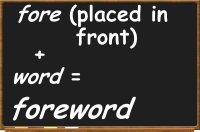
blackboard_foreword_forward2This morning I opened a digital book that was sent to me, expecting to browse its genius. The genius will have to wait, because two words on the cover and repeated in the book’s front-matter derailed me: “Forward by…”

NO! Nothing screams “your editor needs a stronger cup of coffee” louder than “Forward by…”

Let’s talk homophones, shall we? Homophones are words that are pronounced the same way but differ in meaning, and may differ in spelling.

Look: forward and foreword. You notice one has an ‘a’ in it. The other doesn’t. You’ll notice one has an “e’ in it. The other doesn’t. With me so far?

Forward relates to movement. Someone can pull forward. They can go forward. They can even be forward. Why there is even a way that forward is used as a noun–a position on a basketball team near and dear to Charles Barkley’s heart–power forward. (And I suspect you’d understood the relative meaning of that term if you got in front of Barkley as he was moving towards the hoop.) See? Movement!

Then there is foreword. What you have here is a prefix ‘fore’ added to ‘word.’ So what does that give you? A ‘before word.’ This, my friends, is the section of a book that comes before the book’s main words.

If you’re writing a book (or any document, for that matter) that will have a foreword, make sure it’s a foreword and not a forward. And I mean, really–would you want Charles Barkley to welcome people to your literary gem?

Carry on!

Uncategorized

Improving Our Craft

Always on the lookout for ways to get better at what we do, I’ve endeavored a series of posts here that I hope will provide some great insights and thought provocation where our craft is concerned. How does the old saying go? If the shoe fits … Drink deeply!

BullseyeiconMark Twain once said, “I didn’t have time to write a short letter, so I’ve written a long one instead.” What he meant was that it takes work to write succinctly. Or as I’ve encouraged before: Write it; then trim it. Nothing can improve our writing like the delete key!

Here I’ll offer a handful of the words you could (read: should) target:

Literally – When something is true in a literal sense, you don’t need to add the word literally. It clutters. The only time you should use the word literally in your writing is when you need to clarify that you’re serious when it is entirely possible that you are joking. Suppose a well-trained athlete wrote, “I literally ran five miles today.” Literally is a wasted word. It should read, “I ran five miles today.” He’s a great athlete. We take him at his word. Now if I wrote, “I ran five miles today” you wouldn’t believe it. (Nor should you!) So if by some miracle I actually did run five miles, that would be a place where literally would bring clarity–Darin’s not kidding, he literally did it. Are you okay, Darin? Do you need oxygen?

Very – Let’s be honest: very is a very weak word. The rock is very hard. How much harder than hard is very hard? Have you ever met a soft rock? When we use very in a sentence we’re attempting to intensify the description. But the description doesn’t need intensifying. Your reader gets it. Rocks are hard. Really. Oh, and there’s another …

Really – Just like very, really is another oft wasted word. “It’s really important that you sign up.” Try this: “Sign up! It’s important!” Do you see what I mean? Really really adds nothing. In fact, it takes away from the aim–which is “sign up!” Sort of like the word literally mentioned above, unless your reader has some reason to doubt the point you’re making, the word really should be chopped.

Totally – I think this one is a holdover from the Jeff Spiccoli vocabulary from Ridgemont High (or perhaps the Teenage Mutant Ninja Turtles), “That’s totally awesome, Dude!” But (imagine this in Mr. Hand’s voice) let’s consider the meaning of the word totally, shall we? It means … wait for it … in totality. Consider this sentence: “I was totally shocked.” Can you be partially shocked? You’re either shocked or your not. So which it is? Write “I was shocked.” That says all you need to say.

I get that we all go kicking and screaming through the trim phase. But try me on this one–cut those words out and see for yourself, your writing will be better for it! Nothing screams literary novice quite as loudly as frequent appearances of literally, very, really and totally in your writing.