Uncategorized

Help! Grammar Man!

It’s happened to you. Probably just this morning at the local cafe. The courteous server delivered your omelette and cheesy hash browns, reached to top off your coffee and asked, “How is everything?” Everything? Really? Everything?!? You are nonplussed! Does this inquisitive soul want to sit down? This could take quite a while. She’s asked. You’ll oblige. You begin, “Well, I woke up in the middle of the night with a painful charley horse; then, wouldn’t you know it, I couldn’t get back to sleep; I stared at the alarm-clock for hours; worried about my bills–did you know that my health insurance company wants to raise my deductible? Again?!? …” That kindly server wishes desperately for a chance to amend her question, “How is your breakfast?” But you’re only just getting started. “…and I have to go back to that doctor because I’ve got this fungus under my toenails, and…”
grammar manThe Case of Perturbing Pronouns

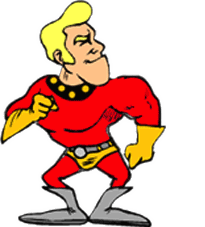
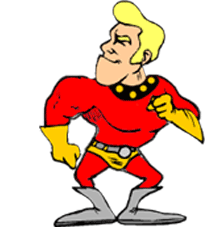
In today’s episode our hero has been called upon to clarify proper pronoun and scope agreement. He arrives on scene–at the Cafe de Mot–and is immediately greeted, “And how are we this morning?” Egads! There is no time to waste. This is a job for … Grammar Man!

Words like everything, everybody and we are pronouns. Reminder from your early days in grammar class: pronouns generally stand for a noun or a set of nouns–that’s called the pronoun’s antecedent–whose identity is made clear by the context. Go ahead, read that definition again. It will help.

It is all too commonplace and dangerous form to use a broad pronoun when context is narrow. You can make this scene unfold yourself the next time your breakfast server opens so-wide a door. The toe-fungus usually gets quite a response. It can also be a lot of fun to simply say, “I’ve got a lot of gas this morning.” If you say it loud enough it might even open up a few seats around you.

But it’s also assumed that when a pronoun is substituted for nouns in a sentence, that the hearer will be clever enough to recognize the scope of context. If your server is asking the question, this inquiry likely references the meal set before you. Doh! So who is at fault? Who is in the wrong? What’s a grammarian super hero to do?

With words like everything and everybody the confusion is likely rooted in the first part of the word–every. Every is, by itself, and adjective. Grammarians, all together now: that means it modifies a noun. So every bicycle, every donut, and every last penny means to convey that all are included, and none are excluded. When compounded into a pronoun with the nebulous thing–imagine the possibilities!

We is a different story. That is a personal, plural, first person pronoun. We includes within it, I. This word should never be used as the exampled usage above. Consider this experience from Grammar Man’s past. Once he needed surgery. It was relatively minor, but Grammar Man isn’t a fan of doctors … with scalpels. The scrub nurse asked, “How are we this morning?” Do you see how ridiculous that is? We? Well, we’re just about to pee our pants!

Here’s the conclusion: When it comes to personal pronouns, the offender needs to be schooled. Grammar Man recommends a mild reprimand: “I think you meant to ask ‘How are you doing?'” Methinks that one or more such reminder will be sufficient to cure the offender of the faux pas. Where a thoughtlessly broad pronoun use is introduced into very narrow context–say over breakfast–Grammar Man suggests you accept the fact that so many flawed communicators inhabit our world. Throw your hands in the air. Scratch your head. Then try to be coy in your response, so as to educate. Try perhaps the following: “You’ve just used a very broad pronoun, everything. Interpreting pronouns requires one to consider context to define its antecedent. You’ve just served me eggs. Aha! My breakfast is fine. Thank you.”

On second thought … go with the toe-fungus and gas. And tune in next time when Grammar Man sorts out the difference betwixt every day and everyday.

Seen any glaring grammatical errors lately? Who uses the word betwixt anymore?
Uncategorized

Eight Minutes

I am presently participating in a writing class offered through the Literary Kitchen and one of my writing mentors, Ariel Gore. Among our assignments each week is a ‘Quick Write’ exercise, which is to be completed in eight minutes or less, in response to a prompt. For this week’s QW, the prompt was ‘What can happen eight minutes?’ Here’s my tongue-in-cheek QW#3 entry:

What can happen in eight minutes? You can seriously further my writing life!

In eight minutes, you could go to Amazon.com and order a copy of my book Big Buts of the Bible: A Revealing Look at Jesus Christ. Did you know that as soon as you hit ‘purchase’ my sales rank improves like a million spots? A handful of your friends join you and, voila!—I’m a best-seller.

Or, if you’ve read a copy, you can go to Amazon.com and write a stellar review for me. That can have a tremendous effect on my book’s visibility. It helps those sales numbers all the more. I’ll be a whore about it—I’ll reciprocate! I’ll tell the world what a literary genius you are, too.

In eight minutes you could follow @Big_Buts on Twitter. Join the thousands who have a thing for big buts! Then you could retweet me—nothing like showing your but to your friends.

In the same eight minutes you could like Big Buts on Facebook. Won’t it be fun when your FB crowd sees “Ariel likes big buts!” come across the news feed? And oh, the fun you’ll have, explaining that it’s buts with one ‘t’, not butts with two. You could even sing ‘Conjunction Junction, what’s your function…’

In so doing you’re helping grow my platform. Thank you. I am, after all, the world’s foremost expert on buts. Says so on my LinkedIn page, so it must be true.

In eight minutes you could tell several of your friends, “I know this guy who likes buts buts!” Toss them my links. Can’t hurt, right? I think that’s how Sir-Mix-A-Lot did it in the 80s.

In eight minutes you could visit my writing website and either follow via email or subscribe to the RSS feed. While you’re at it, you could look at my Big Buts website, too. Chock-full-o-buts, it is! darinmichaelshaw.com & bigbutsofthebible.com … And GO!

In less than eight minutes you can go to iTunes and become somewhere around the 12,000th subscriber to my podcasts. Search Darin Michael Shaw in the iTunes store. Make me famous. Maybe some day an agent or a publisher will give a damn.

Can you spare a wannabe author like me eight minutes?

And last, but not least, you can type as completely self-centered and self-serving a piece as I just did—all in under eight minutes. I know. I’m good!

Uncategorized

The Write Tools

My writer friends and I often talk about the tools we’ve discovered to actually help us put words on a page. Those tools range everything from hardware to software, pens to moleskine journals, settings to environments, snacks to libations. I’ve decided to sing the praises of a few of my writing tools here in a series of posts.

photoIn earlier posts I’ve shared the computer hardware and software that powers my writing endeavors. Today I want to champion a few old-school tools–the reference books and resources I turn to as I write. To be sure, there are online versions of writer’s tools, and I utilize several. But for the most part, I still like to pick up the book and hold it in my hands, dog-ear or otherwise mark important pages, highlight and underline.

Of necessity: A great reference set includes a good Dictionary, Thesaurus, Dictionary of Synonyms & Antonyms, Rhyming Dictionary and Etymology Dictionary. The dictionary and thesaurus need no explanation. The Synonyms and Antonyms tool I use less often, but frequently enough so as to highly recommend it. I don’t suspect you need me to remind you what synonyms and antonyms are, but suffice to say when you’re working on a manuscript and trying to avoid monotonous word repetition, or looking to make a strong contrast, this tool is a friend. It can help paint a scene. Rhyming Dictionaries are most helpful in you’re writing poetry or song lyrics. The best of them rhyme sound fragments, not just words. I attempt poetry and compose lyrics. I use this often. Finally, the Etymology Dictionary is important to me because some of my writing is of the historical fiction genre. It’s important not to use words or phrases before they originated. Understanding where it came from, and the earliest appearances of a word or phrase in literature is a huge help.

Of these tools, I possess two sets of all the above by Merriam-Webster–one kept on my desk in my den at home, the other on my desk at my office. I also have online versions of all the above set in my laptop browser for quick access. I do have a couple of deeper-intellect dictionaries around, too, in case I need to impress someone from Oxford or something.

Less-often used, but still valuable to me, I have a few Famous Quotations and Familiar Quotations books. I always sound smarter when I share someone else’s wisdom and can properly attribute it.

On the craft of writing: I highly recommend four books. Stephen King’s On Writing–A Memoir of the Craft is a great read. Lots of wisdom for my writing life in there. I’ve revisited it a number of times. My writing coach Ariel Gore’s How to Become a Famous Author Before You’re Dead is another I put in the must-read category for anyone seriously desiring to cultivate a writing life. The standard Elements of Style by Strunk & White and the entertaining Eats, Shoots and Leaves by Lynne Truss, are also books I highly recommend every writer own and enjoy.

Last but not least in this area, I’m convinced a good writer must also be a great reader. I have a set aside time to read built into each day. I have a pretty good collection of books that I own. But invaluable to me are also my library card and my Kindle Paperwhite. They help assure that I am never without good reads at my fingertips.

How about you? Any reference tool suggestions you can offer up? How about reading tools or strategies? 

Uncategorized

A Babysitter Memory

I am presently participating in a writing class offered through the Literary Kitchen and one of my writing mentors, Ariel Gore. Among our assignments each week is a ‘Quick Write’ exercise, which is to be completed in ten minutes or less, in response to a prompt. For this week’s QW, the prompt was ‘Allow an image or memory to come to mind while considering the word ‘babysitter.’ Write about it.’ Here’s my QW#2 entry:

Greg Seidel was going to spend the night at my house. The coolest kid in the fifth grade—the first kid picked in pick-up games, the fastest, most agile athlete on every team, the first boy fifth grade girls noticed—was spending the night at my house! That would easily make me the second coolest kid in the fifth grade.

Tragedy! My parents announced they were going out for the evening and having a friend over wouldn’t work. I begged. I pleaded. I bargained—I’d do more than my share of chores. Big sister Diann stepped in to save my life. She offered that she could babysit both Greg and me.

We were having fun. But it turned south, fast. Diann told us we needed to quiet down. Greg sarcastically mocked her. She scolded us. He talked back. The tension mounted, and I began to get nervous. I knew my sister. Before I could warn him, the two were locked in a fiery exchange.

“Listen you little punk!” she demanded. “I’m bigger than you. I’m badder than you. I’m meaner than you. And I’m a helluva lot madder than you. You’d better shut your mouth!”

Greg crossed the line. He mimicked, “I’m biiiiiger, I’m baaaaader, I’m meeeeeener …” Greg’s life flashed before my eyes. Diann formed a perfect fist. It was like one of those slow motion scenes from the movie Rocky—you know, where the punch lands, and spit and blood go flying from flapping jowls. The coolest kid in the fifth grade was ass-end over tea-kettle across my living room, his lip swelled to the size of a kielbasa before he even hit the ground. The coolest kid, reduced to a puddle of blood and tears by my sister.

Uncategorized

Help! Grammar Man!

grammar-manWanted: Stephani Joanne Angelina Germanotta, 5’1″, 125lbs. Last seen wearing clown-like make-up and an outfit made entirely out of red meat. If she’s discovered while composing lyrics, she should be considered armed and dangerous. This is a job for … Grammar Man!

The Case of Ghastly Gaga Grammar

In today’s episode our hero has been called upon to right the world in the wake of Lady Gaga’s repeated pronoun abuses. Teens everywhere are being brainwashed. You and me? You and I? You and me and I, oh my! Help! Grammar Man!

Consider Gaga’s 2009 smash hit Bad Romance. The line that serves up the song’s title reads, “You and me could write a bad romance.” Could they really? But the faux pas don’t end there. Consider next her 2011 single You & I. Though she tried to cleverly couch her grammar gaff amidst samples of legendary rock band Queen’s mega hit We Will Rock You, the lyric repeatedly includes the line “You and I, You and I, Something about you and I.” Uh, no.

Grammatically speaking, the respective lines should read “You and I could write a bad romance” and “You and me … something about you and me.” Shame on you, Gaga! Shame. On. You.

To be fair, I acknowledge that sometimes we struggle with when to use ‘me’ and when to use ‘I’ because a well-meaning teacher, parent or do-gooder scolded a correction at us, “Not you and me! It’s you and I.” Uh, perhaps. Don’t allow correctional certitude to trump proper grammartude (that’s a made up word, but Grammar Man reserves the right to make up words while in the act of fighting for literacy).

Me or I? Grammar Man has a very easy little trick to help assure you never get this wrong again. Are you ready for this? Wait for it. … Wait some more. …Just a little longer. … (I know. Grammar Man is being annoying now.)

Simply take the ‘you and’ out of the sentence and you will never get this wrong again. An example? ‘You and me should listen to Lady Gaga’ or ‘You and I should listen to Lady Gaga’? Technically, neither of us should listen to Lady Gaga, we’ll come away grammatically dumber for the experience. But if we’re choosing between the two sentences, drop the ‘you and’ — Would you say ‘me should listen to’ or ‘I should listen to’? Voila! You got it.

Another? ‘Lady Gaga invited you and I backstage’ or ‘Lady Gaga invited you and me backstage’ — which one is correct? Your turn. I’ll wait. … Still waiting. … If you said ‘me’ than you’re on your way to the head of the class. And worth noting: I just used you’re and your in the same sentence–another couple of words that are frequently tangled and mangled. Perhaps another case for … Grammar Man!

Tune in next time when Grammar Man sets out to help waiters and waitresses everywhere avoid embarrassment.

Can you think of other common word or punctuation errors that trouble society? Trouble you, personally?