Uncategorized

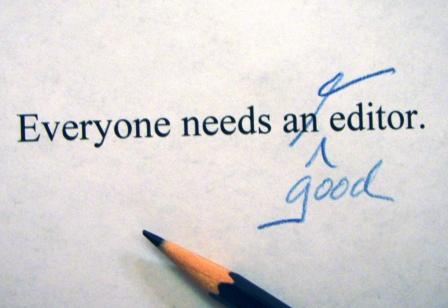
Who Needs an Editor? You!

OLYMPUS DIGITAL CAMERAThere is just no getting around this truth, author: you need an editor. If I got a nickel for every typo or mistaken word choice that has been found in finished manuscripts, I’d be on my way to wealth. And a good number of those have been in my own manuscripts.

I was recently hired to format a manuscript for self-publishing through Smashwords and CreateSpace. In my initial consultation with the client I asked if the manu had been professionally edited. The client told me that she–the author–had a degree in journalism, and assured me that she had been “over that thing a million times.”

Here’s a reality for you to ponder: when we look at our own writing, we see what our minds intended much more clearly than what our hands actually typed. Read the first paragraph again. You see that I put myself in there–I am not a good editor for my own work. My writing friend, you are not a good editor for your work.

While formatting–and not even looking at the manu like an editor–I found a handful of obvious-to-me mistakes. If I found several while not even looking for them, be sure there are more. I called this to the author’s attention. She was embarrassed. I told her not to be. This is to be expected! I recommended we send the manu to an editor before I format it for publishing. The client agreed. Oh happy day!

We want to produce the best finished product we can. We need to involve an editor. It’s really a small investment that pays big dividends.

Next time: What kind of editor/editing do I need?

Any self-editing epic fails you care to share?


Uncategorized

Help! Grammar Man!

grammar man(Call this a getting ready for the start of baseball season edition.)

“Playing right field, number 18, Shane Victorino!”

You know what happens next. The sound system thunders out the Flyin’ Hawaiian’s walk-up music. Then thousands of voices unite to sing along with Bob Marley, the familiar refrain, “Every little thing is gonna be alright!”

But wait! Is it alright? Or is it all right? And with this potential grammar gaff–can anything be all right or alright ever again? This is a job for … Grammar Man!

The Case of All Sorts of Confusion

Grammar man is nothing if not efficient. In today’s episode, the crusader will tackle three sets of confusing words in one fell-swoop. There’s all together (two words) versus altogether (one word), all ready (two words) versus already (one), and finally the aforementioned all right (two words) versus alright (not even a word at all). Oops! Have I let the cat out of the bag? Truth be told, this is one of Grammar Man’s pet peeves. Makes his eye twitch. That sort of thing.

Shall we begin by tackling the words that are really words, first? Methinks!

All together (two words) and altogether (one word) are real words with different definitions. So sorting out confusion here is as easy as understanding definition for context. All together means collectively assembled. The crowd sang Shane Victorino’s walk-up song all together. See? Here’s a trick that will help: When the words all together are called for, you can separate them in the sentence and it still makes sense. The crowd all sang Shane Victorino’s walk-up song together.

The one word version has a different definition. It means entirely. The turkey wasn’t altogether done. Oh no! Don’t eat raw turkey. You’ll get worms! And, referring back to the trick, you can’t break this word into two. All the turkey wasn’t together done. Say what? I’m not sure what that means, but I think I’ll stick with a salad.

All ready and already are very similar to the all together and altogether example above. Start with definitions. All ready speaks of preparedness. Already speaks of time past. And with these two words the same separating trick applies. The turkey is all ready to eat. Cooked through. Carving knives, please? All the turkey is ready to eat. Got it. Heard you the first time. Already? Not so much. The turkey is gone already? All the turkey is gone ready? Aha!

Now to tackle the greatest villain of them all: alright. Grammar Man is a purist at heart. Though society may sway, your wordsmith hero stands firm for the cause. Alright is not a word. All right is the real deal. It is true that alright has gained acceptance in pop culture. Do you remember when you were younger and you’d say “ain’t” and someone would tell you that ain’t ain’t a word? Well, it isn’t, and to prove it, Grammar Man’s grammar checker just rejected it. Ha! Popular use should not a word make. The fact that some have added ain’t to their dictionary … Egads!

Regardless, alright is not a word. Neither is irregardless. Another peeve for another time. All right means satisfactory or okay. All right?

So, when you’re at Fenway and Shane Victorino heads to the plate, make sure you sing really loud, “Every little thing is gonna be ALL RIGHT!” –and correct those around you who sing it wrong!

Irregardless? Are you kidding me? Next time. Grammar Man needs an aspirin.

Uncategorized

I. Am. Ghost.

ghostOne day I was a preacher. The next, I was a ghost.

That could be the start of a pretty good tale. I guess, in one sense, it is. It’s my story. Or at least the start of a new chapter in my story. What will people think when I start to change all my online profiles, changing my career listing from Preacher to Ghost?

Dictionaries define ghost as an apparition, a disembodied spirit, something remarkable or startling. Yep, that about sums me up.

Of course, I’m not talking ghost in a paranormal sense, but in a literary sense. I. Am. Ghost.

You read my work. But you don’t know that it’s mine. And I like that. You ask me “Who have you written for?” I don’t tell. And I like that, too.

My method is simple. I view the authors I represent as characters in a novel. I observe. I draw up a character sketch. I build a continuity file. I intersect with them at a particular point of their story arch. And as I write, they speak. The best compliment I receive is when someone says, “I heard the author’s voice so clearly!” Yes you did! I know, because I spent months living inside of them, to capture every nuance of their passion, voice, tone and style. I’m now more the literary them than they are. Gotcha!

The reality that I’m out here should make you wonder with every book you read: Did the person named on the front cover, whose picture is on the back, whose bio is listed in the flap really write this? I’ll never tell.

I. Am. Ghost.

Uncategorized

The Write Tools

cheeseitsMy writer friends and I often talk about the tools we’ve discovered to actually help us put words on a page. Those tools range everything from hardware to software, pens to moleskine journals, settings to environments, snacks to libations. I’ve been singing the praises of a few of my writing tools here in a series of posts. You can revisit posts on hardwaresoftwarereferences & resources, accouterments and some of my social media tools.

This installment of the tools that help my writing heart tick will be a little different. With this one I’m really going to promote a discipline more than things. Reading. People who are a lot smarter than me have said if you want to write you need to excel at reading. Lest you think I’m kidding:

“If you don’t have time to read, you don’t have the time (or the tools) to write. Simple as that.” ― Stephen King

“Read everything–trash, classics, good and bad, and see how they do it. Just like a carpenter who works as an apprentice and studies the master. Read! You’ll absorb it. Then write.” ― William Faulkner

Think I’m kidding? Erasmus is considered one of the great human minds of all time. What did he think of reading? “When I get a little money, I buy books. If any is left, I buy food and clothes.” — Erasmus

Personally, I have tended to practice the Faulkner quote above. I woke up to the reality a few years back that the only books I was reading were those recommended to me because they would gel with my wiring and thinking. In other words, I’d find kinship with the author, the subject matter or story. I made an intentional change. I started reading different points of view, different styles and voices. I picked up some genres I’d never read before. And I believe my writing craft has grown for it.

I’d encourage you, make time in your day–every day–for some reading. Your writing will benefit.

In case you’re curious, here are a handful of titles I’ve read in the past twelve months (some of which I’d recommend, others which I would not!) to give you an idea of the diversity: Team of Rivals (Doris Kearns Goodwin), Platform (Michael Hyatt), Aesop’s Fables, Love is an Orientation (Andrew Marin), Off Magazine Street (Ronald Capps), Atlas of the Human Heart (Ariel Gore), The Adventures of Sherlock Holmes (Arthur Conan Doyle).

What are you reading these days? What reading has fed your writing life recently?