For twenty-one years I served as a pastor. For more than a decade since, I’ve made my living as a writer, drawing on both my theological education and pastoral experience to craft hundreds of daily devotional reflections.
Several years ago, that writing took a new direction. I began writing specifically for those carrying the weight of depression, anxiety, trauma, addiction, and recovery—and for the family members and friends walking beside them. These reflections were written for hurting people searching for hope.
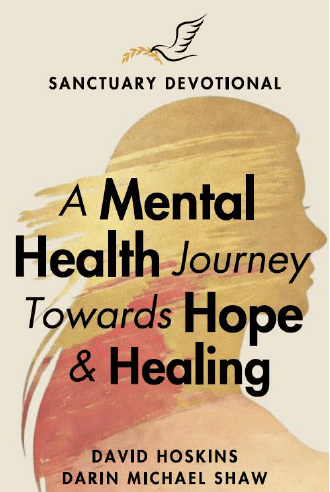
I’m grateful that an entire year’s worth of those devotions, written in collaboration with Dr. David Hoskins, founder of Sanctuary Clinics and Sanctuary Communities, will soon be available in book form as Sanctuary Devotional: A Mental Health Journey Towards Hope & Healing.
The book begins by explaining how this project came to be and the hope that gave it life. Here is a brief excerpt from the Introduction, followed by today’s devotional reading for July 28th, O How He Loves Us.
INTRODUCTION
FINDING SANCTUARY IN THE FATHER’S EMBRACE
It all started a few years ago under the large print of Rembrandt’s masterpiece, The Return of the Prodigal, hanging in the great room at Sanctuary Clinic’s Monticello Campus. As we sat beneath that image of the father’s hands resting on the shoulders of his broken son, our conversation gravitated toward a shared reality: we are both prodigals.
Between the two of us, we have sat on every side of the recovery table. We have known the desperate, hollow emptiness of addiction and the “muck and weeds” of pastoral ministry. We have felt the terrifying loneliness of trying to shepherd others while wrestling with our own mental health struggles in the dark. But most importantly, we have both experienced the Fatherly love of God expressed in that parable—a love that does not wait for us to be “whole” before it welcomes us home.
A COMMUNITY BEYOND THE BUILDING
In our journeys toward the Father’s embrace, we discovered a vital truth: no one recovers in isolation. We were sustained by the prayers of devoted families and the presence of a greater Community. We aren’t just talking about the church building down the street, but the “Church” with a capital C—that great cloud of witnesses who have struggled, stumbled, and searched for God in the same valleys we walk today.
In moments of crisis, when we cried out for wisdom from someone who “knew,” someone in human flesh who had been there, we discovered an entire company of saints. We found that giants of the faith like Augustine, C.S. Lewis, Charles Spurgeon, Henri Nouwen, and Mother Teresa were not untouchable statues of perfection. They were men and women who wrestled to find God within a twisted, fallen world. Their writings have spanned generations because they speak the language of the hurting.
THE PURPOSE OF THIS DEVOTIONAL
This book is the culmination of that discovery. We have acted as curators, gathering a legacy of light from those who spoke into our own suffering. We have designed this resource to be a “Sanctuary” for your morning and evening—a place where the clinical reality of mental health meets the eternal reality of God’s grace.
We know that for the person navigating recovery or mental health challenges, the gap between what we know (“God is good”) and what we feel (“I am broken”) can feel like an ocean. These pages are intended to bridge that gap.
WELCOME HOME
If you are holding this book, you are no longer walking alone. You are being welcomed into the Sanctuary Community—a fellowship of believers who recognize that mental health treatment, recovery, and deep spiritual transformation are not only compatible, they are often inseparable.
Whether you are the one struggling, or the one walking beside someone who is, there is a place for you here. The Father’s hands are already reaching out. Welcome to the journey home.
— David Hoskins and Darin Michael Shaw

JULY 28 ~ O HOW HE LOVES US
IN WORD
“These things I have spoken to you, that my joy may be in you, and that your joy may be full.” — John 15:11
IN THOUGHT
“God does not just ‘love’ us through gritted teeth; out of the eternal freshness of His being, He cherishes us with unstintingly affectionate regard. This love, like Jesus’ personality, is full of joy.” — Dallas Willard, The Divine Conspiracy
IN REFLECTION
Dallas Willard powerfully reframes our understanding of God’s character, tearing down the false image of a “morose and miserable monarch” or a “policeman on the prowl.” Instead, by confronting Jesus’ declaration, “He that has seen me has seen the Father,” we must recognize that God’s core nature is expressed through an abundance of joy. This joy was not ruled out by Jesus’ experience of sorrow or grief; rather, it was a steady, underlying happiness—an inheritance He left to His students.
The most comforting revelation here is that God does not just love us without liking us. He cherishes the earth and each human being upon it with fondness, endearment, and unstintingly affectionate regard. This is a love of another kind—a natural outflow of His perpetually self-renewed being.
For those grappling with shame, self-contempt, or the fear of being truly known, this truth is the foundation of health and wholeness. It means God’s regard for us is rooted in His perfect nature, not our imperfect performance.
As the praise song “Oh How He Loves Us” declares, the more fully we recognize the greatness of His affections, the more His love eclipses whatever we are struggling with in this lifetime. Whether it is the darkness of depression, the burden of addiction, or the weight of past failures, His overwhelming affection brings strength for the journey. This love is not fickle or conditional; it is utterly dependable and eternally fresh. Let us long for it, cling to it, and find our strength in Him. What specific affliction or struggle is most threatening to eclipse your joy today, and what affirmation of God’s “unstintingly affectionate regard” can you speak over yourself right now?
IN DEED
Find a quiet moment to look in a mirror and tell yourself: “God cherishes you with fond and affectionate regard.” Choose to believe that He likes you today, regardless of your productivity or performance.